The 26th edition of the United Nations Climate Change Conference, also known as the Conference of Parties (COP26), commenced in the city of Glasgow on 31st October. The conference was attended by 20,000 attendees from 200 countries and over 120 heads of state’s addresses, highlighting the plans of their nation against the impending crisis. The Conference is attended by the signatory nations of the United Nations Framework Convention on Climate Change and the parties to the Paris Climate Accords-2015.
Aim
of the Conference:
The
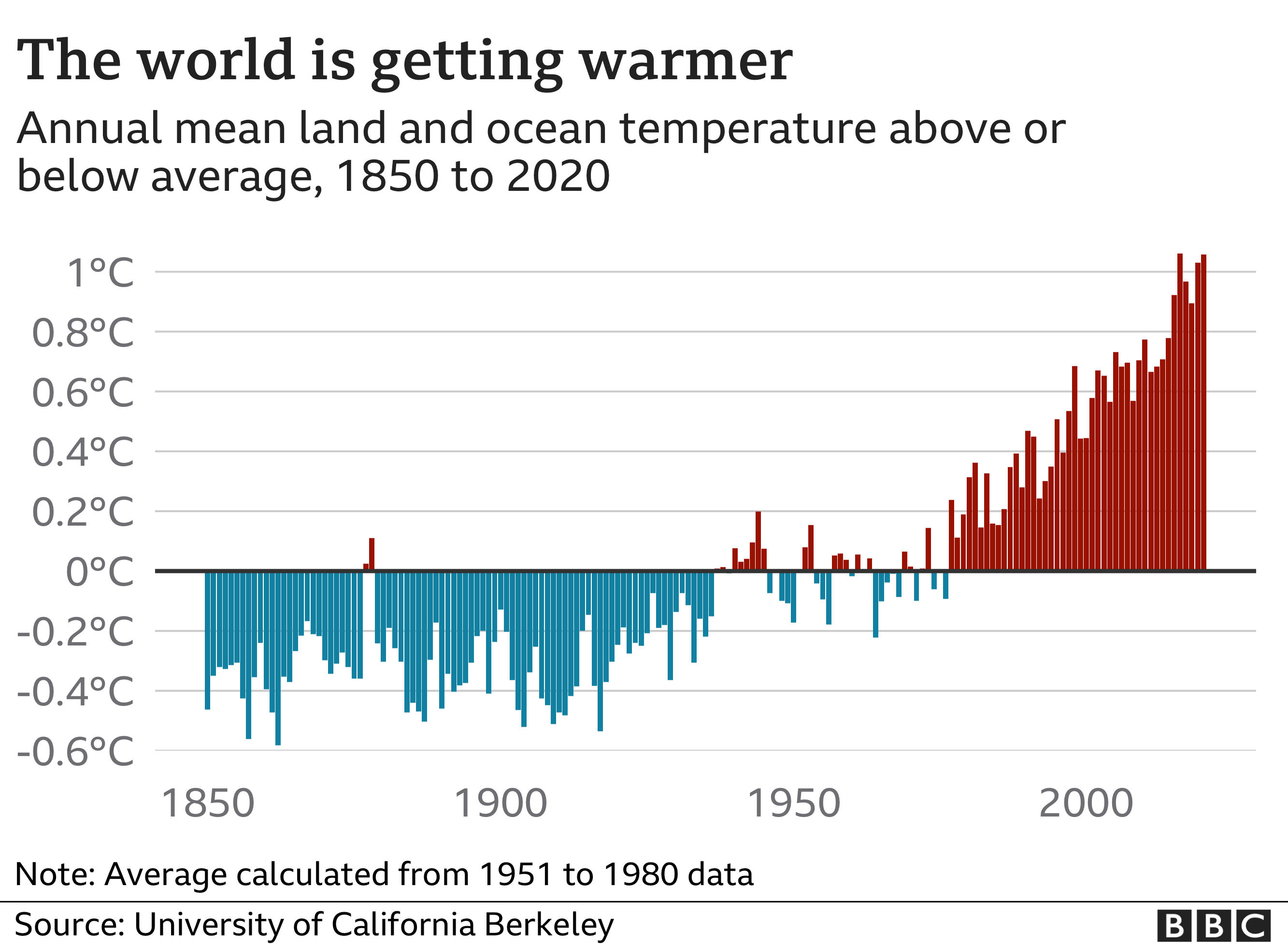
Paris Climate Accords announced for a global net-zero carbon emissions by 2050
to keep the mean rise (above pre-industrial levels) in temperatures below 2⁰C
(preferably 1.5⁰C) and prevent irreversible damages to the environment. The
rise currently is slightly over 1⁰C.
Moving
forward on the same, the COP26 had 4 major aims to reach consensus on:
1.
Global
net-zero deadline: Countries are being asked to come forward with ambitious 2030 emissions
reductions targets that align with reaching net zero by the middle of the
century.
2. Adapt to protect communities and natural habitats: To enable and encourage countries affected by climate change to protect and restore ecosystems and build defences, warning systems and resilient infrastructure and agriculture to avoid loss of homes, livelihoods and even lives.
3. Managing finances: To deliver on our first two goals, developed countries make good on their promise to mobilise at least $100bn in climate finance per year by 2020.
4. Collaboration and Planning: Countries
to finalise the Paris Rulebook (the detailed rules that make the Paris
Agreement operational) and accelerate action to tackle the climate crisis
through collaboration between governments, businesses and civil society.
Major Highlights of the Conference so far…..
·
UK, US, Germany, Netherlands and
Norway partnered with 17 funders to raise $1.7billion to invest in Indigenous People
and Local Communities across the globe who play a major role in conversing biodiversity
in the forest.
·
110 world leaders signed a pledge to
end deforestation by 2030 and revive the unused and damaged lands through
afforestation. Countries that have joined in for the pledge account for 85% of
global forest cover.
·
The US re-joined the Paris Climate Accords
after Donald Trump withdrew from the Accords in 2020. President Joe Biden even
announced his plan to achieve net-zero emission no later than 2050.
·
40 countries including Canada, Ukraine,
Indonesia and Vietnam have consented to end the use of coal for their energy
requirement at the earliest. The developed nations have set an aim of 2030
while others have their aim at 2040. Larger nations like UK, US and Denmark stop
investment in fossil fuel projects worth a cumulative estimate of $8 billion.
- The Global Energy Alliance for
People and Planet comprising of several philanthropies, development finance
institutions and governments aim to unlock $100billion via various public
and private capital to reach 1 billion underserved people with
reliable, renewable power; avoid and avert 4 billion tons of carbon emissions; drive economic growth, with 150+ million created, enabled, or improved.
India and its Policies:
Prime Minister
Narendra Modi addressed the conference on November 1 highlighting the commitment
of India to create a sustainable future. India is the fourth largest contributor
to global carbon emissions however per capita emissions fall way behind major
developed nations.
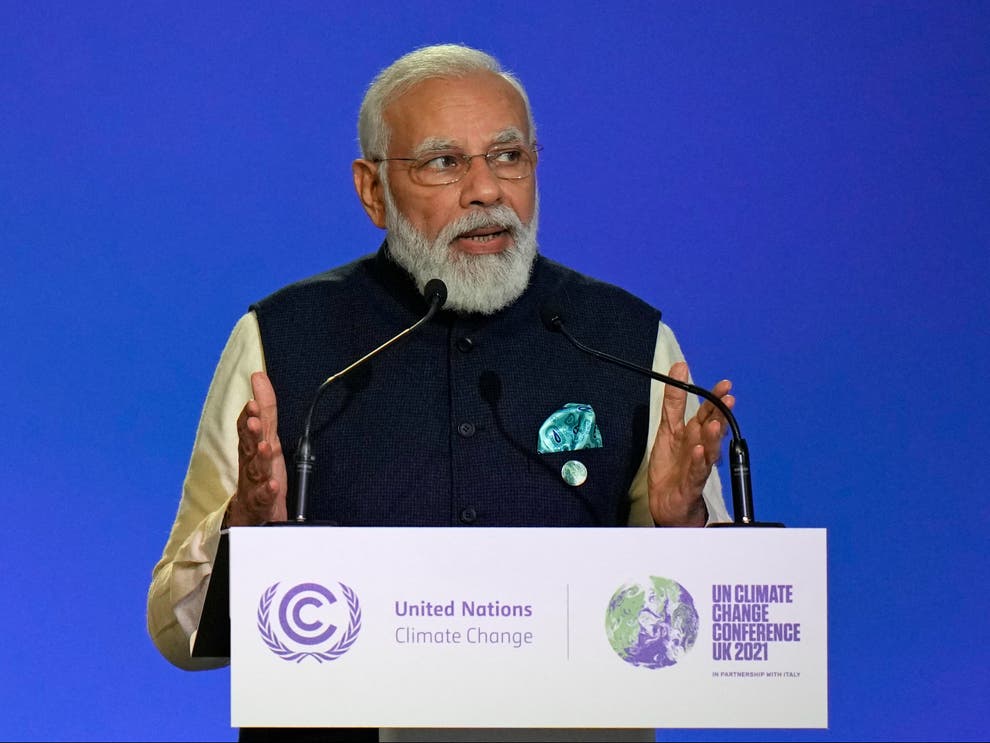
Hon’ble PM
announced 5 commitments that India will achieve in the upcoming years:
·
Achieve net-zero emission by 2070.
·
Increase non-fossil energy capacity
to 500GW by 2030
·
Bring its economy’s carbon intensity
down to 45% by 2030
·
Fulfill 50% of energy requirement by renewable
sources by 2030
·
Reduce 1 billion tonnes of carbon emission
by from total projected emission by 2030.
Apart from these
announcements, he even emphasised the importance of changing lifestyle to
tackle climate change at an individual level. He highlighted the work done by the Indian government to attain its aim of net-zero emission like the Indian Railway’s
target of reaching net-zero emission by 2030 and reducing carbon emission by 40
billion tonnes through the use of LEDs. India has increased its renewable
energy capacity by 25% over the last 5 years.
The aim to reach net-zero
by 2070 is probably is being called out to be way beyond the limit. Moreover, there
is a concern that being a developing nation India will see a further increase
in energy requirement and it will take time to reach a maximum before the concrete reduction
in carbon emission will be visible in attaining net-zero. According to a study
based on data by NASA, Kolkata, Mumbai and Chennai are at the risk of massive
floods or partial submerge by 2050 due to rising sea levels.
Distribution of Power Consumption:
|
CATEGORY |
INSTALLED GENERATION CAPACITY (MW) |
% SHARE |
|
FOSSIL FUEL |
||
|
COAL |
2,01,955 |
51.9 |
|
LIGNITE |
6,620 |
1.7 |
|
GAS |
24,900 |
6.4 |
|
DIESEL |
510 |
0.1 |
|
TOTAL |
2,34,024 |
60.2 |
|
NON-FOSSIL FUEL |
||
|
HYDRO |
46,512 |
12.0 |
|
SOLAR, WIND & OTHER |
1,01,533 |
26.1 |
|
NUCLEAR |
6,780 |
1.7 |
|
TOTAL |
1,54,825 |
39.8 |
The current consumption
from renewable sources stands at 38.1% of total consumption (excluding nuclear
energy). The government has planned to increase grid-solar power to 100GW by March
2023 and will play a major role to attain the 50% RE target. However, the
initiative is currently underperforming with only 43.94 GW grid-solar power
installation as of August 2021.
To read more about
India’s solar power initiatives, click here.
The government has
a concrete policy, the National Action Plan on Climate Change launched in 2008,
shape its strategy against climate change. However, we have yet to see any concrete
legislation being drafted out of it to control and monitor climate change.
Moreover, recently the government faced criticism after proposed amendments in the Forest (Conservation) Act, 1980 that eased the use of forest land for particular
development and construction works.
The government has
to carefully plan out the way ahead since the population rise is expected to
reach the upper limit in 2060 at an estimated number of about 1.65 billion.
To meet the basic requirements of such a large population in a “developed India”
and simultaneously maintaining its promises of COP26 will indeed be a herculean
task.
Comments
Post a Comment